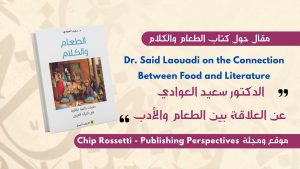
الدكتور سعيد العوادي عن العلاقة بين الطعام والأدب
بمناسبة مرور سنة على تتويج “الطعام والكلام”بجائزة الشيخ زايد ضمن فرع الفنون والدراسات النقدية للأستاذ الدكتور سعيد العوادي، يكتب المترجم والمحرر الأمريكي المرموق تشيب روستي مقالا قيما عن الكتاب في موقع PUBLISHING PERSPECTIVES المتخصص في صناعة النشر العالمي، والتابع لمعرض فرانكفورت الدولي للكتاب.
Dr. Said Laouadi on the Connection Between Food and Literature

By Chip Rossetti
In 2025, Dr. Said Laouadi won a Sheikh Zayed Book Award in the Literary and Art Criticism category for his 2023 book al-Ta‘am wal-Kalam (Food and Speech), a wide-ranging study of metaphors of food and eating as an integral part of Arabic literary heritage. A professor of rhetoric and discourse analysis at Cadi Ayyad University in Marrakech, Laouadi focuses his research on the intersection of rhetoric and culture.
His award, which he calls “the culmination of a long scholarly journey,” was originally prompted by a line he came across in 13th century book, The Key to Sciences, by a Central Asian rhetorician named Abu Siraj al-Sakkaki. In it, al-Sakkaki noted that there are two kinds of meals that a generous host serves to guests: the first is food (a meal for the body) and the second is speech (a meal for the spirit.) Properly employed language, in al-Sakkaki’s words, is “the most delicious nourishment for the soul and the finest meal laid out for guests.”

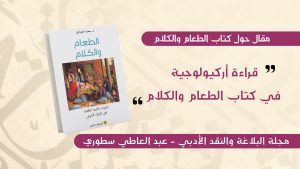
Food and Speech book cover
With that line, Laouadi made the realization that “speech is food,” an insight at the heart of the research that would eventually be published as Food and Speech. As he developed this theoretical approach, it became obvious that food was a crucial organizing metaphor in pre-modern Arabic writing. As with English, the Arabic language is riddled with expressions and turns of phrase that link speech with eating or food. He points out that this is true in contemporary Arabic, too: a pleasant conversation is called “sweet” (hilw) and a witty one is “salty” (mustamlah). Enjoyable talk is “easy to swallow” (mustasagh), while immature writing is called “unripe” (ghayr nadija). As in English, Arabic speakers talk about “devouring a novel” and being “a voracious reader.”
Even more fundamental to criticism, Laouadi notes, is the concept of “taste” (dhawq), which has traveled far from its original culinary meaning to encompass arts and literature. The Arabic term adab has taken a similarly lengthy journey: originally it referred to politeness and good table manners, but over the centuries came to mean refined literary writing and now means literature in general.
Laouadi’s study is filled with surprising examples pulled from medieval Arabic texts that demonstrate how deeply the language of food infuses literature, including plenty of book titles that reference food, usually conveying the idea that its contents offer the reader a feast of information. In other places, he points to ancient maxims on literary concision and style, such as “Good literary style is the starvation of utterance and the satiation of meaning.”
Given the somewhat abstruse field of “cultural rhetoric” that is the focus of his research, Laouadi acknowledges the impact that the Sheikh Zayed Book Award had on his public profile, noting its reputation for “high seriousness” and the high regard in which it is held.
“The award brought me quite a lot,” he adds. “It helped me get the word out about my scholarly project and gave me added confidence.” As a result, his book has had “an exceptional response”: it has spawned a number of articles in Arabic and been the subject of panels at Oxford, King Saud University in Saudi, and his own Cadi Ayyad University. The success of Food and Speech encouraged him to delve further into the theme of food in literature, by examining food in the contemporary Arabic novel. The result was Matbakh al-Riwaya (The Novel’s Kitchen: Food in Fiction from Visuality to Textual Interweaving), published in 2024.
Having exhausted his analysis of food as metaphor, Laouadi is now focusing his critical lens in a new direction by looking at the impact of professional occupations on early Arabic literature. “I am putting the finishing touches on a new book,” he explains, examining how those working in trades—as artisans, builders, merchants, and other tradesmen—helped to manufacture critical, rhetorical, and discourse. Far from being marginal to the development of literary culture, he argues, these professions have left an outsize impact on it. “They are like shadow professors who had an influence on the words of writers, critics, and rhetoricians.”
About the Author
رابط المقال الأصلي